School Information Management System for Modern Educational Institutions
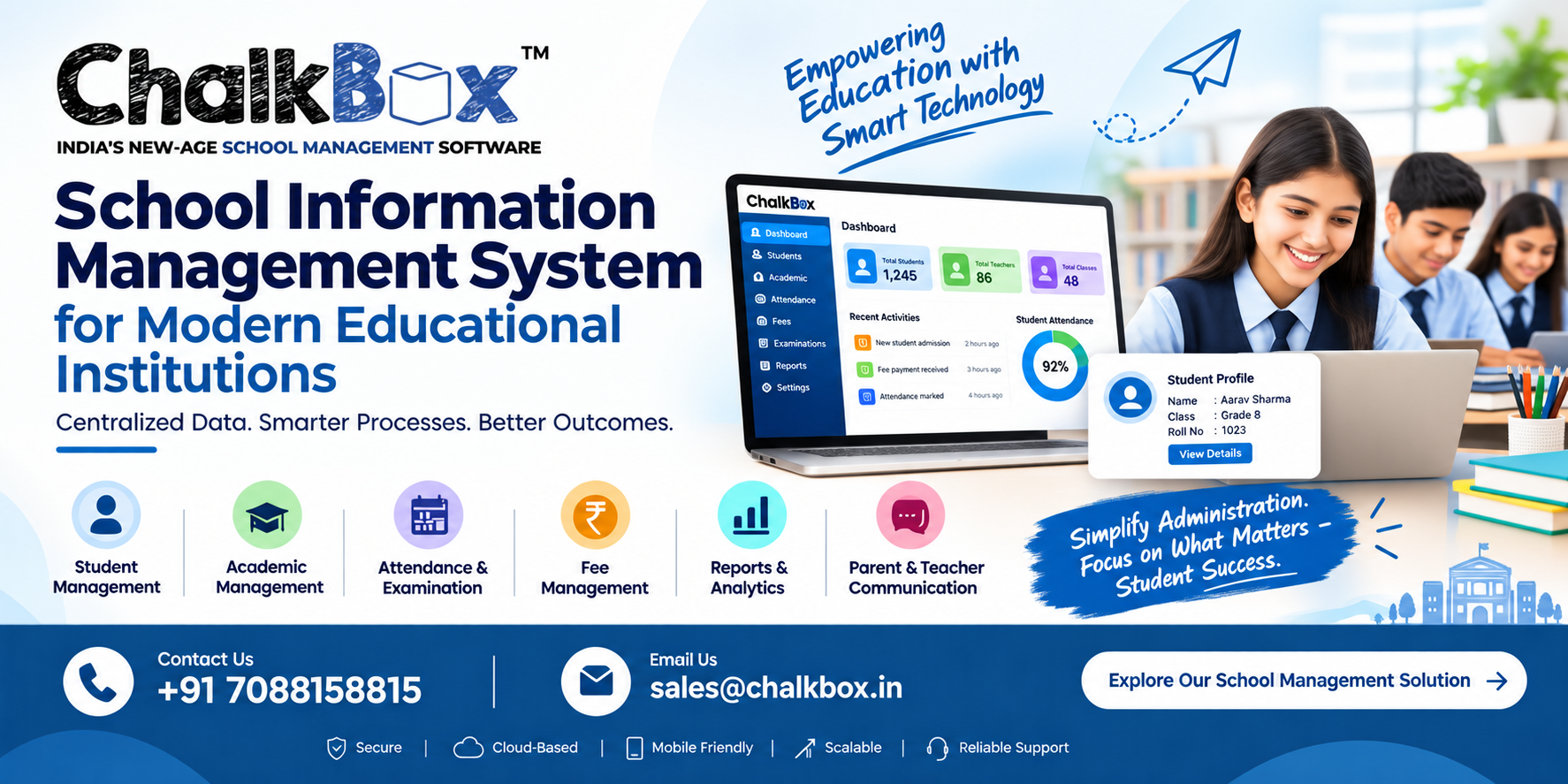
Managing an educational institution involves hundreds of activities every day. Student records, admissions, attendance, examinations, fees, staff information, communication, academic performance, and administrative reports all need to be maintained accurately.
Traditional registers, spreadsheets, and disconnected applications can make these processes difficult to manage as an institution grows. A School Information Management System provides a centralized digital platform that helps schools organize important information and streamline everyday operations.
Similarly, a Student Information Management System focuses on maintaining comprehensive student records, while an Educational Management Information System can provide administrators with broader institutional data and reporting capabilities.
For colleges and higher-education institutions, College Management System Software in India can bring academic, administrative, financial, and communication processes together on a single platform.
ChalkBox helps educational institutions move toward organized, technology-enabled management with solutions designed around modern educational workflows.
What Is a School Information Management System?
A School Information Management System is software designed to collect, organize, manage, and retrieve information related to school operations.
Instead of maintaining information in multiple registers or spreadsheets, schools can maintain data within a centralized digital environment.
Depending on the platform and requirements of the institution, a School Information Management System may include:
- Student registration and admission
- Student profiles
- Attendance management
- Teacher and staff records
- Fee management
- Examination management
- Timetable management
- Academic records
- Parent communication
- Reports and analytics
- Document management
- Notifications and announcements
- Transportation management
The primary purpose is to make school information easier to manage while reducing repetitive administrative work.
What Is a Student Information Management System?
A Student Information Management System is a specialized solution for maintaining and managing student-related information throughout the student's academic journey.
A student's information can include:
- Personal details
- Parent or guardian information
- Admission information
- Class and section
- Attendance
- Academic performance
- Examination results
- Fee information
- Certificates and documents
- Communication history
- Health or emergency information, where appropriate
A centralized Student Information Management System allows authorized users to access relevant student information without searching through physical files or multiple spreadsheets.
For administrators, this can improve record organization. For teachers, it can provide quicker access to academic information. Parents can also benefit when selected information is made available through a parent portal or mobile application.
Why Schools Need a School Information Management System
Schools today manage considerably more information than simply student attendance and examination marks. Admissions, finance, academics, staff, communication, and reporting all contribute to the institution's daily workload.
A School Information Management System can help address several common administrative challenges.
1. Centralized Information
Information from different departments can be organized within one system. This reduces the need to maintain multiple disconnected records.
2. Reduced Paperwork
Digital records can reduce dependence on physical registers and repetitive documentation.
3. Faster Information Retrieval
Authorized users can search for student, staff, academic, or administrative information without manually checking multiple files.
4. Better Data Accuracy
Centralized data entry and structured workflows can help reduce duplicate or inconsistent records.
5. Improved Reporting
Administrators can generate reports related to attendance, academics, fees, admissions, and other operational areas.
6. Better Collaboration
Teachers, administrators, and parents can access relevant information according to their roles and permissions.
Key Features of a Student Information Management System
A comprehensive Student Information Management System should cover the complete student lifecycle.
Student Profile Management
Schools can maintain detailed student profiles containing admission information, contact details, academic history, class information, and parent details.
Admission Management
The system can help organize enquiries, applications, registrations, document collection, and admission records.
Attendance Management
Teachers can record attendance digitally, while administrators can monitor attendance patterns and generate reports.
Academic Management
Academic information can be maintained by class, section, subject, teacher, and academic year.
Examination Management
The system can help organize examination schedules, marks, grades, results, and report cards.
Fee Information
Student-related fee records can be maintained alongside other information, giving administrators a more complete view of each student's administrative status.
Parent Communication
Important notifications and updates can be shared with parents through integrated communication features.
Educational Management Information System: What Does It Mean?
An Educational Management Information System is a broader concept that focuses on collecting and analyzing information related to the management of an educational institution or education system.
While a Student Information Management System primarily focuses on individual student records, an Educational Management Information System can provide information across multiple areas.
These may include:
- Students
- Teachers
- Attendance
- Infrastructure
- Admissions
- Examinations
- Fees
- Academic performance
- Staff
- Institutional operations
- Reports and analytics
The broader objective of an Educational Management Information System is to help educational leaders use organized information for planning, monitoring, and decision-making.
School Information Management System vs Student Information Management System
Although these terms are closely related, their focus can be different.
| Area | School Information Management System | Student Information Management System |
|---|---|---|
| Student records | ? | ? |
| Admissions | ? | ? |
| Attendance | ? | ? |
| Teacher management | ? | Limited/Optional |
| Fee management | ? | Student-related |
| Examination management | ? | ? |
| Staff management | ? | Usually limited |
| Institutional reporting | ? | Limited |
| School administration | ? | Limited |
| Student lifecycle | ? | ? |
A School Information Management System generally addresses broader school operations, whereas a Student Information Management System focuses specifically on student data and academic records.
Many modern platforms combine both capabilities to provide schools with a unified digital environment.
College Management System Software in India
The requirements of colleges are different from those of schools. Colleges may manage multiple departments, courses, semesters, faculty members, examinations, student registrations, fees, and academic records.
College Management System Software in India is designed to address these higher-education requirements through centralized digital management.
A college management platform may include:
- Student admission
- Course and department management
- Student registration
- Faculty management
- Attendance
- Timetable
- Examination management
- Internal assessment
- Fee management
- Library management
- Hostel management
- Communication
- Certificates
- Reports
- Academic records
For colleges, selecting suitable College Management System Software in India requires consideration of institution size, number of departments, academic structure, integrations, reporting requirements, and scalability.
Benefits of College Management System Software in India
The use of College Management System Software can simplify several administrative and academic activities.
Centralized College Data
Student, faculty, course, and administrative information can be organized in one system.
Better Academic Administration
Departments can manage academic information, timetables, attendance, examinations, and results more systematically.
Simplified Student Services
Students can potentially access information related to attendance, examinations, fees, schedules, and academic records through digital portals.
Improved Communication
Colleges can communicate announcements and important information through centralized digital channels.
Data-Driven Administration
Reports and dashboards can provide administrators with useful information for monitoring institutional activities.
How an Educational Management Information System Supports Decision-Making
One of the biggest advantages of an Educational Management Information System is the ability to turn large amounts of institutional data into useful information.
For example, administrators can review:
- Attendance trends
- Admission numbers
- Fee collection
- Student performance
- Examination results
- Staff information
- Class-wise statistics
- Department-level information
- Operational reports
Instead of relying entirely on manually prepared reports, administrators can use dashboards and structured reports to understand institutional performance.
However, software should support decision-making rather than replace professional judgment. Data quality, proper configuration, and appropriate access controls remain important.
Important Factors When Choosing School Management Software
Choosing the right School Information Management System requires evaluating more than the number of available features.
Ease of Use
Teachers and administrative staff should be able to understand the interface without extensive technical knowledge.
Scalability
The system should be capable of supporting the institution as the number of students, teachers, departments, and campuses increases.
Security
Educational institutions manage sensitive information. Schools and colleges should evaluate authentication, role-based access, backups, permissions, and other security measures.
Mobile Accessibility
Parents, teachers, students, and administrators increasingly use smartphones. Mobile-friendly access can make daily school management more convenient.
Reporting
The platform should provide practical reports rather than simply storing information.
Integration
Schools may need integration with payment gateways, biometric devices, accounting systems, communication tools, or other applications.
Technical Support
Implementation, training, troubleshooting, and ongoing support are important considerations when adopting a new system.
ChalkBox for Digital Education Management
ChalkBox is an education technology solution focused on helping institutions manage their operations digitally.
A modern School Information Management System can help bring student records, admissions, attendance, fees, examinations, communication, and reporting into a connected environment.
For institutions looking for a Student Information Management System, centralized student records can simplify the management of information throughout the academic lifecycle.
Similarly, organizations seeking an Educational Management Information System can benefit from structured data, reporting, and centralized administrative workflows.
For higher-education institutions evaluating College Management System Software in India, the ability to manage multiple academic and administrative functions through a unified platform can be an important consideration.
The Future of School and Educational Information Management
Digital transformation in education is moving toward connected platforms rather than isolated applications.
Future-focused information management solutions are increasingly expected to support:
- Cloud-based access
- Mobile applications
- Automated workflows
- Real-time dashboards
- Digital communication
- Online payments
- Advanced reporting
- Role-based access
- Data security
- Multi-campus management
- Integration with other educational technologies
A modern School Information Management System should therefore be flexible enough to adapt as the institution's requirements change.
Frequently Asked Questions
What is a School Information Management System?
A School Information Management System is a digital platform used to organize and manage information related to students, teachers, admissions, attendance, fees, examinations, communication, and other school operations.
What is a Student Information Management System?
A Student Information Management System manages student-related information such as profiles, admissions, attendance, academic records, examination results, and parent information.
What is an Educational Management Information System?
An Educational Management Information System is a broader information-management framework that helps educational institutions collect, organize, analyze, and report institutional data.
What is College Management System Software?
College Management System Software is designed to help colleges manage students, faculty, courses, departments, attendance, examinations, fees, communication, and other academic and administrative activities.
Why use College Management System Software in India?
College Management System Software in India can help institutions centralize academic and administrative information, reduce manual processes, improve communication, and generate structured reports.
Can schools and colleges use the same management software?
Some platforms can support both schools and colleges, but requirements can differ significantly. Schools should evaluate whether the software supports their specific academic structure, workflows, reporting needs, and administrative processes.
Conclusion
A well-designed School Information Management System can help educational institutions organize information and streamline everyday administration. From admissions and attendance to examinations, fees, communication, and reporting, centralized digital management can reduce manual effort and improve accessibility.
A Student Information Management System provides a structured way to manage student information throughout the academic lifecycle, while an Educational Management Information System can provide broader institutional visibility.
For higher-education institutions, College Management System Software in India offers a way to bring student, faculty, academic, examination, and administrative processes into a connected digital environment.
For schools and colleges planning their digital transformation, the key is to select software that combines usability, scalability, security, reporting, and relevant functionality rather than choosing a platform based solely on the number of features.
Explore ChalkBox
ChalkBox – India's New-Age School Management Software
???? Contact: +91 7088158815
?? Email: sales@chalkbox.in
???? Website: chalkbox.in

Chalkbox is unique, comprehensive and easy to use web based school management software. A team of experts have developed software that is reliable and secure platform to solve your school management problems. With the idea to help schools, we provide everything what they need.