Best School ERP in India: Transforming Modern School Management
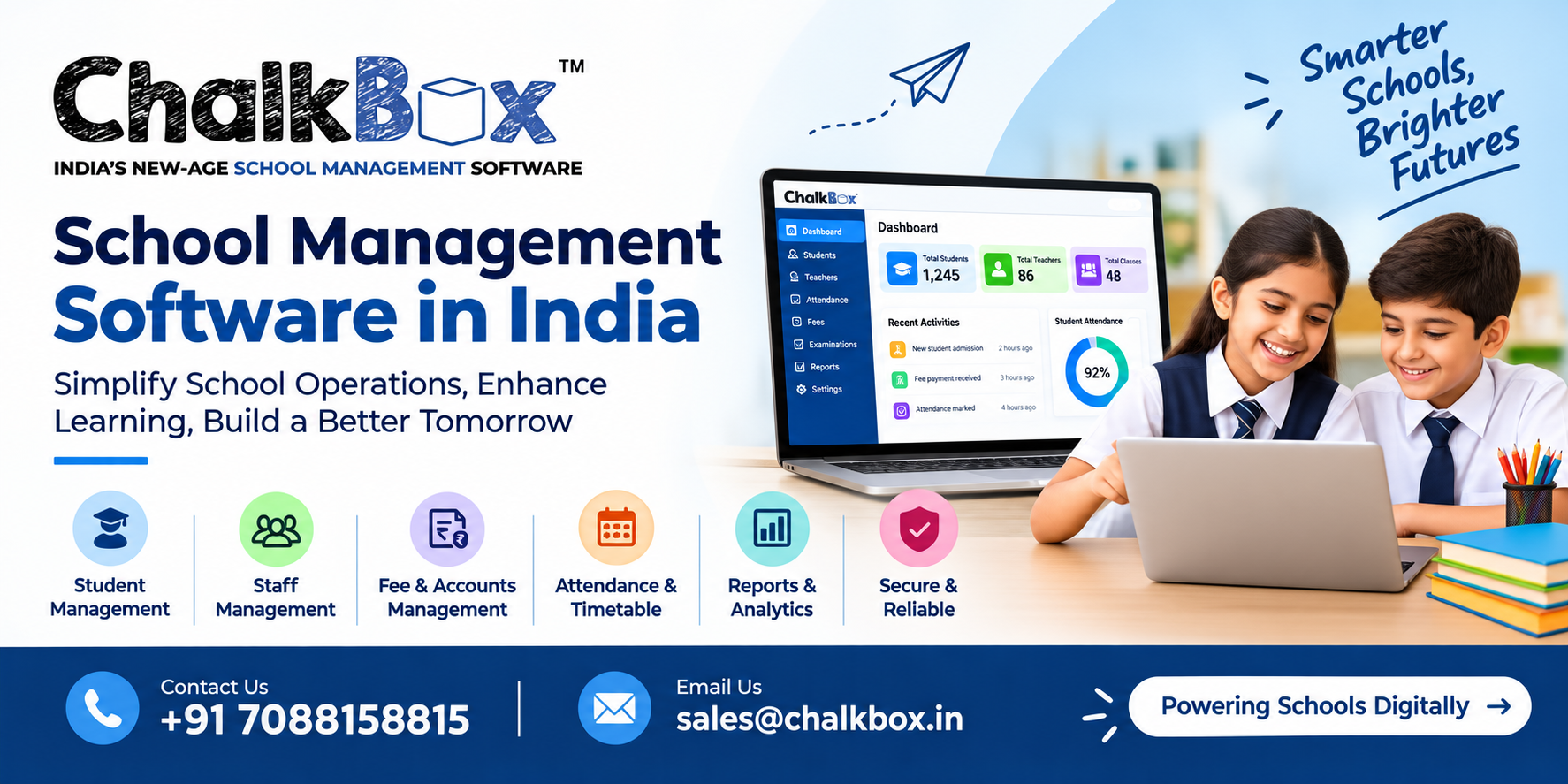
Managing a school involves much more than teaching students. From admissions and attendance to fee collection, examinations, communication, staff management, transportation, and reporting, administrators handle hundreds of daily activities. Managing these processes manually can consume valuable time and increase the possibility of errors.
A School ERP in India brings these activities together on one centralized digital platform. With a modern school management system, schools can automate routine processes, improve communication, organize information, and make data-driven decisions.
For schools looking for a reliable School ERP Software, the most important consideration is not simply the number of features. The right platform should be easy to use, scalable, secure, mobile-friendly, and capable of supporting the school's actual operational requirements.
ChalkBox is designed around the needs of modern educational institutions, helping schools move toward a more organized and digitally connected approach to administration.
What Is a School ERP?
A School ERP, or Enterprise Resource Planning system for schools, is an integrated software platform that manages different academic and administrative operations from a single system.
Instead of maintaining separate applications or spreadsheets for different departments, a School Management Software can connect important functions such as:
- Student admission and registration
- Student information management
- Attendance management
- Fee management
- Examination and results
- Timetable management
- Teacher and staff management
- Parent communication
- Homework and academic activities
- Reports and analytics
- Transportation management
- Notifications and announcements
A well-designed School Management System gives administrators a centralized view of school activities while helping teachers, parents, and students access relevant information.
Why Schools Need School ERP Software in India
Indian schools manage a large amount of information every day. Student records, attendance, fee transactions, examination results, staff details, certificates, communication, and administrative reports all need to be maintained accurately.
Traditional manual processes can make these activities time-consuming.
A modern School ERP Software can help schools automate repetitive tasks and maintain information digitally.
1. Centralized Student Information
A School Management System can maintain student information in one centralized database. Administrators can manage admission details, academic information, attendance records, parent information, documents, and other relevant data without maintaining multiple disconnected records.
This can make information retrieval faster and improve coordination between departments.
2. Simplified Admission Management
Admissions are an important part of school administration. A digital admission module can help schools manage enquiries, applications, student details, document requirements, registration, and admission status.
With School Management Software, administrative teams can reduce paperwork and maintain a more structured admission workflow.
3. Easy Attendance Management
Attendance is an essential daily activity. Teachers can record student attendance digitally, while administrators can monitor attendance information through centralized reports.
Depending on the school's requirements, a School ERP in India may also support different attendance methods and notifications.
Digital attendance records can help schools identify attendance trends and maintain organized records.
4. Efficient Fee Management
Managing school fees manually can involve significant administrative work. A School ERP Software can bring fee structures, invoices, payments, outstanding balances, receipts, and reports together in one system.
Parents can also benefit from convenient access to fee-related information when online payment and parent portals are available.
5. Examination and Result Management
Examinations involve multiple activities, including creating examination schedules, managing marks, calculating results, preparing report cards, and maintaining academic records.
A modern School Management System can streamline these activities and reduce repetitive data entry.
Teachers and administrators can access relevant academic information while maintaining a consistent digital record.
Key Features of the Best School ERP in India
When evaluating the Best School ERP in India, schools should consider functionality as well as usability and scalability.
Here are some important features to look for.
Student Management
A comprehensive student management module should allow schools to maintain student profiles, academic information, documents, parent details, and other essential records.
Teacher and Staff Management
A centralized platform can help schools manage employee profiles, attendance, responsibilities, schedules, and other staff-related information.
Attendance Management
Digital attendance makes it easier to record, monitor, and report student attendance. Automated notifications can also improve communication between schools and parents.
Fee Management
Schools should look for fee management capabilities that support fee structures, receipts, payment tracking, dues, concessions, and reporting.
Examination Management
An effective School Management Software platform should help manage examination schedules, subjects, marks, grades, report cards, and result analysis.
Timetable Management
Creating timetables manually can be complicated, particularly for larger schools. A digital timetable module can help administrators organize classes, teachers, subjects, and schedules.
Parent Communication
Communication is a critical part of modern school management. Notifications, announcements, messages, attendance updates, academic information, and other communication tools can keep parents connected with the school.
Reports and Analytics
A good School ERP Software should provide useful reports that help administrators understand school operations and make informed decisions.
Benefits of Using a School Management System
Implementing a School Management System can provide benefits across different areas of school operations.
Improved Administrative Efficiency
Automation reduces repetitive paperwork and manual data entry. Staff can spend more time on important administrative and academic responsibilities.
Better Data Organization
Centralized information makes it easier to find and manage records. Schools can maintain consistent information across departments.
Faster Communication
Digital communication tools enable schools to share announcements and updates with parents, teachers, and students more efficiently.
Reduced Manual Work
Routine activities such as attendance records, fee receipts, reports, and notifications can be streamlined through School Management Software.
Better Decision-Making
Reports and dashboards can give administrators greater visibility into attendance, fees, academics, admissions, and other school activities.
Improved Parent Experience
Parents increasingly expect convenient digital access to school-related information. A suitable School ERP in India can provide access to important information through web or mobile interfaces.
School ERP Software for Different Types of Schools
One of the important factors when selecting School ERP Software is whether it can adapt to different institutional requirements.
CBSE Schools
CBSE schools may require structured academic, examination, attendance, fee, communication, and reporting processes. A configurable School Management System can help organize these activities.
ICSE Schools
ICSE schools can also benefit from centralized student, academic, examination, staff, and administrative management.
Private Schools
Private schools often need an integrated platform for admissions, fees, attendance, communication, academics, and administration.
International Schools
International schools may have more complex operational requirements and can benefit from scalable School Management Software with configurable modules.
Multi-Branch Schools
Schools operating multiple branches can benefit from centralized reporting and standardized processes while allowing individual branches to manage their daily activities.
How to Choose the Best School ERP in India
Choosing the right platform requires more than comparing feature lists. Schools should evaluate how well the software fits their operational requirements.
1. Understand Your School's Requirements
Before selecting a School Information Management System, identify the processes that need automation. This could include admissions, attendance, fees, examinations, transportation, communication, or staff management.
2. Evaluate Ease of Use
A powerful platform is useful only when teachers and administrative staff can use it comfortably. Look for a clean interface and simple workflows.
3. Check Scalability
The school's requirements may change as student numbers increase. The selected School ERP Software should be capable of supporting future growth.
4. Consider Mobile Accessibility
Teachers and parents frequently use smartphones. Mobile-friendly access can make a School Management System more convenient for everyday use.
5. Review Security
Schools manage sensitive student, parent, staff, and financial information. Data security, access controls, authentication, backups, and appropriate permissions should therefore be important evaluation criteria.
6. Examine Support and Training
Implementation is easier when the software provider offers onboarding, training, technical support, and assistance during the transition from manual systems.
7. Look at Integration Capabilities
Schools may use payment gateways, biometric devices, communication platforms, accounting systems, or other technologies. Integration capabilities can make a School Management Software platform more useful.
ChalkBox: A Modern Approach to School Management
ChalkBox is a school technology platform focused on helping educational institutions manage their everyday operations digitally.
With an integrated approach to school administration, schools can use a School Management System to organize important processes and provide better digital access to administrators, teachers, students, and parents.
A modern School ERP Software platform can bring multiple school functions together rather than requiring administrators to work across numerous disconnected systems.
For schools exploring a School ERP in India, ChalkBox can be considered as part of the evaluation process based on the institution's specific requirements, workflows, and technology needs.
The Future of School Management Software
Education technology is moving beyond simple digitization. Modern schools increasingly require connected systems that provide real-time information, automation, communication, analytics, and convenient access.
The next generation of School Management Software is expected to focus on:
- Automation of routine administrative tasks
- Mobile-first experiences
- Data-driven school management
- Integrated communication
- Digital payments
- Real-time dashboards
- Better parent engagement
- Cloud-based accessibility
- Secure data management
- Scalable school technology
The objective is not simply to replace paperwork with software. A successful School Management System should help schools create more efficient and connected workflows.
Frequently Asked Questions About School ERP Software
What is a School ERP?
A School ERP is an integrated software platform that helps schools manage academic, administrative, financial, and communication-related activities from one centralized system.
What is the difference between School ERP and School Management Software?
The terms are often used interchangeably. A School ERP Software generally refers to a broader integrated platform covering multiple departments, while School Management Software may refer more specifically to tools used to manage school operations.
Why should schools use School Management Software?
Schools can use Educational Management Information System to reduce manual work, centralize information, automate repetitive processes, improve communication, and generate useful reports.
What features should the Best School ERP in India have?
Important features can include student management, admissions, attendance, fee management, examination management, timetable management, staff management, communication, reports, dashboards, and mobile access.
Is School ERP Software suitable for small schools?
Yes. A scalable School ERP Software platform can be useful for schools of different sizes, provided its modules and pricing align with the school's requirements.
How can a School Management System improve parent communication?
Digital notifications, announcements, attendance updates, fee information, examination results, and parent portals can make communication more accessible and organized.
Conclusion
A reliable School ERP in India can become an important part of a school's digital transformation. By bringing admissions, student management, attendance, fees, examinations, communication, reporting, and other operations into one platform, schools can create more organized and efficient workflows.
When evaluating the Best School ERP Software in India, schools should focus on usability, scalability, security, features, integrations, support, and how well the platform matches their actual requirements.
With the right School Management Software, schools can reduce administrative complexity while creating a more connected digital experience for administrators, teachers, students, and parents.
Looking for a modern School Management System? Explore ChalkBox and discover how digital school management can simplify everyday operations.
Contact ChalkBox:
???? +91 7088158815
?? sales@chalkbox.in
???? chalkbox.in

Chalkbox is unique, comprehensive and easy to use web based school management software. A team of experts have developed software that is reliable and secure platform to solve your school management problems. With the idea to help schools, we provide everything what they need.